
















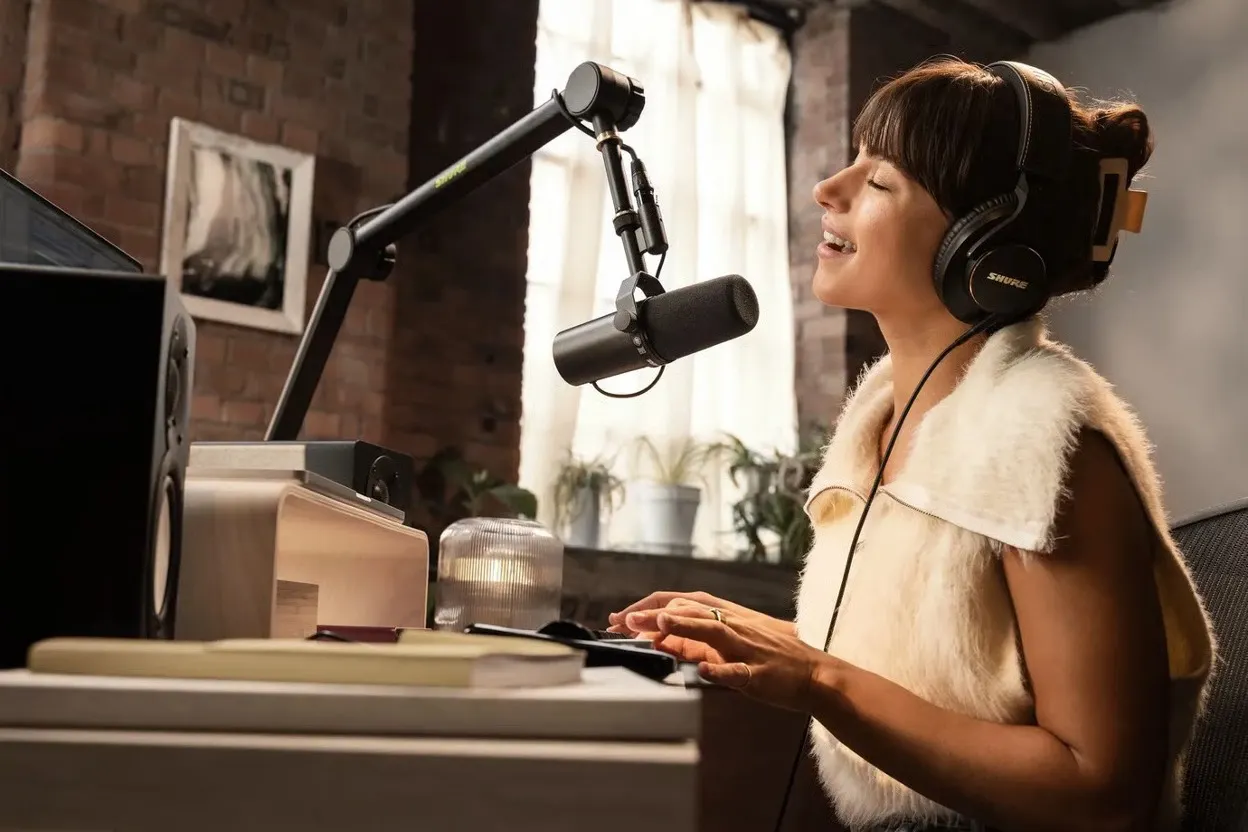
For decades, Shure has defined the sound of global broadcasting, legendary studio albums, and premier podcast productions. While sensitive condenser microphones often capture unwanted ambient room echo, computer fans, and keyboard clicks, Shure’s dynamic microphone architecture prioritizes acoustic isolation, rich low-end proximity, and bulletproof electromagnetic shielding.
From the legendary studio-grade SM7B to the modern hybrid DSP-driven MV7+, Shure provides the definitive toolkit for podcasters, live streamers, broadcast voice-talents, and recording artists.
Core Product Portfolio & Flagship Microphones
1. The Industry Icon: Shure SM7B (XLR Dynamic)
The SM7B remains the definitive broadcast dynamic microphone across top podcast studios and radio stations worldwide:
- Cardioid Polar Pattern & Off-Axis Rejection: The tailored polar pattern isolates the speaker’s voice while actively rejecting lateral and rear noise, making it forgiving in untreated or semi-treated home studios.
- Internal Air Suspension Shock Isolation: Built-in pneumatic shock absorption and an internal humbucking coil virtually eliminate mechanical desk thumps, handling noise, and electromagnetic interference (EMI) from nearby PC monitors.
- Rear Hardware Tone Switches: Features selectable Bass Roll-Off (to cut low rumble) and Mid-Range Presence Boost (to enhance vocal clarity and intelligibility without external EQ).
- Gain Requirement: Due to its low sensitivity ($-59\text{ dBV/Pa}$), the SM7B requires $+55\text{ to }+60\text{ dB}$ of clean gain from a dedicated inline preamp (e.g., Cloudlifter, Shure SM7dB built-in booster) or a high-gain audio interface.
2. The Modern Creator Workhorse: Shure MV7 / MV7+ (Hybrid XLR/USB)
Inspired by the SM7B form factor, the MV7 and MV7+ are engineered specifically for content creators, streamers, and mobile podcasters:
- Dual Output Architecture: Simultaneous USB-C and XLR outputs allow creators to record a direct digital feed to a laptop while simultaneously sending an analog backup track to an audio interface.
- Onboard DSP & Auto-Level Mode: Managed via the ShurePlus MOTIV app, internal DSP handles real-time gain staging, compression, EQ profiles (Dark, Natural, Bright), and the proprietary Voice Isolation Technology to prevent clipping or dynamic volume drops.
- MV7+ Upgrades: Introduces customizable LED touch-panel meters, onboard real-time Digital Popper Stopper™ technology, and enhanced hardware reverb control.
3. Stage & Field Legends: Shure SM58 & Beta 58A
- Indestructible Build Quality: Handheld dynamic workhorses built with heavy-duty steel mesh grilles that survive extreme drops and field conditions.
- Vocal Tailoring: Feature a classic upper-midrange presence peak that cuts through dense soundscapes during live event interviews, field reporting, and stage vocal tracking.
Technical Specifications Comparison
| Metric / Feature | Shure SM7B | Shure MV7+ | Shure SM58 |
| Transducer Type | Dynamic (Moving Coil) | Dynamic (Moving Coil) | Dynamic (Moving Coil) |
| Polar Pattern | Cardioid | Cardioid | Cardioid |
| Connectivity | 3-Pin XLR | USB-C & 3-Pin XLR | 3-Pin XLR |
| Sensitivity | $-59\text{ dBV/Pa}$ (Requires Preamp) | $-54.7\text{ dBV/Pa}$ (XLR) / Active USB | $-54.5\text{ dBV/Pa}$ |
| Onboard Processing | Bass Roll-off & Presence Boost (Switches) | Hardware DSP, Noise Gate, Compressor, Reverb | None (Pure Passive) |
| Headphone Out | None (Monitored via Interface) | 3.5mm Zero-Latency Monitoring | None |
| Primary Use Case | Pro Podcasts, Studio Vocal Recording | Streaming, Solo Podcasting, Hybrid Setups | Field Reporting, Live Events, Stage |
Signal Chain Architecture: Optimizing Your Shure Setup
To get clean, professional broadcast sound out of a dynamic Shure capsule, configure your signal chain according to your connection type:
[Shure SM7B (XLR)] ──► [Inline Preamp / Cloudlifter (+25dB)] ──► [Audio Interface / Mixer] ──► [DAW / OBS]
                                                                        ▲
[Shure MV7+ (USB-C)] ──────────► [ShurePlus MOTIV DSP Engine] ──────────┘
- Positioning & The Proximity Effect: Place the microphone capsule 5 to 10 cm (2 to 4 inches) from your mouth at a $45^\circ$ angle. This maximizes the warm, intimate low-end bass resonance while directing harsh plosive air bursts (“P”, “B”, “T” sounds) past the side of the capsule.
- Boom Arm Decoupling: Mount the microphone on a low-profile or heavy-duty articulating boom arm (e.g., Elgato Wave Mic Arm LP or Rode PSA1+) to decouple the unit from typing vibrations and desk bumps.
- Gain Staging Rules: When using the SM7B without an inline activator, ensure your interface's preamps can deliver at least $+60\text{ dB}$ of gain without introducing background hiss (Equivalent Input Noise $<-128\text{ dBu}$).