















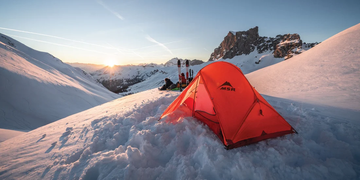








A good night's sleep can make or break a backpacking trip.
When temperatures drop after sunset, staying warm inside a tent is not simply a matter of choosing the warmest sleeping bag. Your sleeping bag, sleeping pad, clothing, tent environment, and the ground beneath you work together as a complete thermal system.
For three-season backpacking, winter camping, and high-altitude expeditions, understanding how this system manages heat loss can help you choose equipment based on measurable performance rather than marketing claims.
Two technologies are particularly important: down versus synthetic sleeping-bag insulation and the R-value of your sleeping pad.
1. How Your Body Loses Heat While Sleeping
The human body continuously produces heat. When you sleep outdoors, your sleep system must reduce the rate at which that heat escapes into the surrounding environment.
There are four major mechanisms of heat transfer:
- Conduction — heat moves from your body into colder surfaces.
- Convection — moving air carries heat away.
- Radiation — your body emits infrared energy toward colder surroundings.
- Evaporation — moisture leaving your skin or breath carries heat away.
For sleeping systems, conduction through the ground is particularly important.
A sleeping bag can be extremely warm, but if the sleeping pad underneath you provides inadequate insulation, your body can still lose significant heat to the ground.
This is why a sleeping bag and sleeping pad should be considered a single thermal system rather than two independent pieces of gear.
2. Why a Sleeping Bag Needs Loft
The primary job of sleeping-bag insulation is not to generate heat.
Instead, insulation works by trapping relatively still air around your body.
Still air is a poor conductor of heat, so creating thousands of tiny pockets of air reduces heat transfer between your warm body and the colder environment.
This is where loft becomes important.
A high-loft sleeping bag creates a thicker layer of insulating material around your body.
The result is greater thermal resistance and, generally, better performance at lower temperatures.
However, loft only works effectively when the insulation is allowed to expand.
Compressing insulation under your body dramatically reduces its ability to trap air.
That is why the insulation underneath you is not a substitute for a properly insulated sleeping pad.
3. Down Sleeping Bags: Maximum Warmth for Minimum Weight
Down remains one of the most effective insulation materials for ultralight backpacking.
High-quality goose or duck down can provide an exceptional warmth-to-weight ratio while compressing into a very small package.
Down quality is commonly described using Fill Power.
Typical premium specifications include:
- 650 Fill Power
- 700 Fill Power
- 800 Fill Power
- 850 Fill Power
- 900 Fill Power
Higher fill power means that a given weight of down can expand to occupy more volume.
For example, 850-fill down can produce more loft per unit of down weight than 650-fill down.
This does not mean that an 850-fill sleeping bag is automatically warmer than every 650-fill sleeping bag.
Total warmth also depends on:
- Amount of down used
- Baffle construction
- Bag shape
- Draft collar
- Hood design
- Footbox construction
- Shell fabric
- Temperature rating
Therefore, fill power should be viewed as an insulation quality indicator, not a complete temperature-rating measurement.
4. Advantages of Down Insulation
High-quality down is particularly attractive to backpackers because of its combination of performance and packability.
Major advantages include:
Excellent warmth-to-weight ratio
Premium down can provide substantial insulation without adding much weight.
Highly compressible
Down can pack into a remarkably small volume, making it ideal for minimalist backpacking.
Long service life
With proper care and storage, a high-quality down sleeping bag can remain useful for many years.
Efficient loft
High-fill-power down can create substantial insulating volume relative to its weight.
For long-distance hikers who carry everything on their backs, these advantages can be significant.
5. The Weakness of Down: Moisture
Down has one major vulnerability: moisture.
When down becomes wet, the delicate clusters can lose loft and clump together.
As loft decreases, insulating performance can also decrease.
This is why moisture management is essential when using a down sleeping bag.
Modern manufacturers address this problem in several ways.
One approach is the use of hydrophobic or water-resistant treated down, combined with shell fabrics designed to reduce moisture penetration.
Sea to Summit's Ultra-Dry Down technology is an example of this approach.
However, water-resistant down should not be interpreted as waterproof insulation.
A down sleeping bag still needs to be protected from:
- Rain
- Condensation
- Wet clothing
- Snow
- Water bottles leaking inside the pack
- Damp tent interiors
6. Synthetic Insulation: The Practical Alternative
Synthetic sleeping bags use manufactured fibers instead of natural down.
Modern synthetic insulation can provide very good thermal performance while offering one important advantage: better tolerance of moisture.
When synthetic fibers become damp, they generally retain a greater proportion of their insulating ability than wet down.
Synthetic insulation is therefore particularly attractive for:
- Humid environments
- Wet climates
- Budget-conscious backpackers
- Users who expect frequent moisture exposure
- Some expedition and emergency applications
The trade-off is usually greater weight and bulk for comparable warmth.
7. Down vs. Synthetic Sleeping Bags
| Feature | Premium Down | Synthetic |
|---|---|---|
| Warmth-to-weight | Excellent | Good |
| Compressibility | Excellent | Moderate |
| Wet-weather performance | Requires careful moisture management | Generally better |
| Weight | Lower | Higher |
| Pack size | Smaller | Larger |
| Longevity | Excellent with proper care | Good |
| Price | Usually higher | Often lower |
| Best for | Ultralight backpacking | Wet climates and value-focused use |
The choice ultimately depends on your environment.
For a dry alpine trip where every gram matters, premium down can be extremely difficult to beat.
For a wet coastal environment or humid multi-day trip, synthetic insulation can offer additional peace of mind.
8. Understanding Fill Power: 650 vs. 850 vs. 900
Fill Power is often misunderstood.
It measures the amount of volume that a standardized amount of down can occupy under specified test conditions.
Higher fill power generally means more loft from less down.
A rough conceptual comparison looks like this:
650 FP → Good performance and value
750–800 FP → Premium performance
850–900 FP → High-end ultralight performance
But the number alone does not determine the warmth of a sleeping bag.
Consider two bags:
- Bag A uses 900-fill down but contains relatively little insulation.
- Bag B uses 700-fill down but contains substantially more down.
Bag B can potentially be warmer.
Therefore, when comparing sleeping bags, look at the complete design rather than focusing exclusively on the Fill Power number.
9. The Sleeping Pad: Your Forgotten Heat Barrier
Many campers spend a considerable amount of time researching sleeping bags while overlooking the sleeping pad.
This is a mistake.
When you lie down, your body compresses the insulation underneath you.
A sleeping bag cannot maintain its normal loft under your body weight.
The sleeping pad therefore becomes the primary barrier between your body and the cold ground.
This is why R-value is one of the most important specifications for a sleeping pad.
10. What Is R-Value?
R-value measures thermal resistance.
In simple terms:
Higher R-value = greater resistance to heat transfer through the pad.
A pad with an R-value around 1.0 provides relatively little insulation and may be suitable for warm conditions.
As temperatures fall, higher R-values become increasingly useful.
A winter-oriented sleeping pad may have an R-value around 5, 6, or 7+, depending on the design.
However, R-value should not be interpreted as a direct temperature rating.
There is no simple rule such as:
“R-value 5 means exactly X degrees.”
Your sleeping bag, clothing, body size, metabolism, tent conditions, humidity, and ground temperature all affect real-world comfort.
11. ASTM F3340-18 and Sleeping Pad Testing
Modern sleeping-pad comparisons benefit from standardized testing.
ASTM F3340-18 established a standardized laboratory method for measuring the thermal resistance of sleeping pads.
This is important because it allows consumers to compare R-values using a more consistent testing methodology.
Rather than relying solely on manufacturer-specific testing procedures, standardized testing provides a common reference point.
A practical way to think about R-value is:
Higher R-value → slower heat transfer through the sleeping pad.
For cold-weather camping, this can be just as important as the insulation rating of your sleeping bag.
12. How R-Values Combine
One useful feature of R-value is that the thermal resistance of multiple insulating layers can approximately be considered additive when the layers are properly stacked.
For example:
Pad A: R 3.0
Pad B: R 2.0
≈
Combined R-value: 5.0
This can be useful when adapting an existing sleep system for colder conditions.
However, real-world performance depends on how the pads interact, their construction, compression, and contact with the ground.
The calculation should therefore be treated as a useful approximation rather than a guarantee of a particular comfort temperature.
13. Therm-a-Rest NeoAir XTherm NXT
The Therm-a-Rest NeoAir XTherm NXT is designed specifically for users who want high thermal insulation without carrying a heavy winter mattress.
Its published R-value of 7.3 places it firmly in the high-insulation category.
The concept behind the design is especially interesting because the pad uses multiple internal layers to reduce heat transfer while maintaining a low packed weight.
For winter backpacking, alpine climbing, and cold-weather expeditions, this type of construction can provide an impressive balance between:
- Thermal insulation
- Weight
- Packability
- Sleeping comfort
A high R-value is particularly valuable when camping directly on frozen or snow-covered ground.
14. Sea to Summit Spark and Flame Sleeping Bags
Sea to Summit's Spark and Flame sleeping-bag families focus heavily on ultralight construction and high-quality down insulation.
High-fill-power down allows manufacturers to achieve substantial loft while keeping the total weight relatively low.
This makes these sleeping bags attractive to backpackers who prioritize:
- Low pack weight
- Small packed volume
- Premium down insulation
- Efficient thermal performance
The Spark series is particularly associated with minimalist ultralight designs, while the broader range allows users to choose different shapes and temperature ratings.
When evaluating one of these bags, don't focus only on the headline fill-power figure.
Look at the actual temperature rating, down quantity, construction, fit, and intended use.
15. NEMO Tensor All-Season Insulated Pad
The NEMO Tensor All-Season Insulated Pad takes a different approach to balancing warmth and comfort.
Its internal construction uses reflective insulation and specialized baffle geometry to limit heat transfer while maintaining a relatively quiet and comfortable sleeping surface.
The design philosophy is important because thermal performance is only one part of a good sleeping pad.
A pad also needs to provide:
- Stable support
- Comfortable pressure distribution
- Low noise
- Reasonable packed size
- Reliable inflation and deflation
- Sufficient insulation for the intended environment
For backpackers who spend many nights on the trail, comfort can be almost as important as shaving a few grams from the pack.
16. Thermal Bridging: The Hidden Problem
Even a high-R-value sleeping pad cannot eliminate every source of heat loss.
A phenomenon called thermal bridging can occur when parts of the sleep system provide less insulation than the surrounding area.
Examples include:
- Gaps between sleeping pads
- Exposed areas near the shoulders
- Thin sections around the edges
- Air movement around the sleeping system
- Insufficient insulation beneath the feet
This is one reason why selecting the correct pad width and length matters.
A pad that is too narrow may leave parts of your sleeping bag directly exposed to the cold ground.
17. Building a Complete Cold-Weather Sleep System
A strong winter sleep system should be considered as a combination of components.
Layer 1: Ground
The ground temperature can be significantly lower than the air temperature.
A suitable groundsheet or protective layer can help protect the sleeping pad from punctures and moisture.
Layer 2: Insulated Sleeping Pad
Choose the R-value according to expected conditions.
For genuinely cold environments, a high-R-value pad becomes increasingly important.
Layer 3: Sleeping Bag
Choose the temperature rating based on the expected conditions rather than the average forecast.
Layer 4: Clothing
Dry base layers can supplement the sleep system.
Avoid going to bed in heavily sweat-soaked clothing.
Layer 5: Shelter
A tent reduces exposure to wind, precipitation, and convective heat loss.
The shelter and sleep system should therefore be considered together.
18. How to Choose the Right R-Value
There is no universal R-value that works for every camper.
A practical approach is to think in broad categories:
| Sleeping Pad R-Value | General Use |
|---|---|
| 1.0–2.0 | Warm-weather camping |
| 2.0–3.5 | Three-season conditions |
| 3.5–5.0 | Cool-weather camping |
| 5.0–7.0 | Cold and winter conditions |
| 7.0+ | Severe cold and expedition-oriented use |
These categories are general guidance rather than official temperature ratings.
Personal cold tolerance can vary considerably.
A person who sleeps warm may be comfortable with a lower R-value than someone who tends to feel cold.
19. The Most Important Mistake to Avoid
One of the most common mistakes in cold-weather camping is buying an extremely warm sleeping bag and pairing it with an inadequate sleeping pad.
For example:
Warm sleeping bag + low-R-value pad = potentially cold night
The reverse can also be inefficient:
High-R-value winter pad + lightweight summer sleeping bag = potentially cold night
The components must be matched.
Think of the system as a chain:
Body heat → sleeping bag → sleeping pad → ground
Every weak link affects the final result.
Down vs. Synthetic vs. High-R-Value Pads
If you're building an ultralight sleep system, a premium combination might look like:
850+ Fill Power Down Sleeping Bag
R-Value 5–7+ Insulated Air Pad
Appropriate shelter and clothing
This approach can provide an excellent balance of warmth, weight, and packability.
For wet environments, however, replacing the down bag with a quality synthetic model may make more sense.
The best system is always the one that matches the conditions.
Final Verdict
Modern sleep systems are remarkably sophisticated.
High-fill-power down allows manufacturers to create sleeping bags that are extremely light and compressible. Synthetic insulation provides an alternative with strong moisture tolerance. Meanwhile, advanced insulated air pads use reflective layers, internal baffles, and carefully engineered materials to achieve high R-values without becoming excessively heavy.
Products such as the Therm-a-Rest NeoAir XTherm NXT, Sea to Summit Spark and Flame, and NEMO Tensor All-Season demonstrate how modern outdoor equipment combines material science with practical backpacking requirements.
But the most important lesson is simple:
A sleeping bag keeps you warm above. A sleeping pad protects you from the cold below.
For serious cold-weather camping, don't evaluate either component in isolation. Consider fill power, insulation quantity, temperature rating, R-value, ground temperature, moisture, and personal sleeping habits as one integrated thermal system.
When those components are properly matched, you can dramatically improve both warmth and sleep quality without unnecessarily increasing pack weight.