



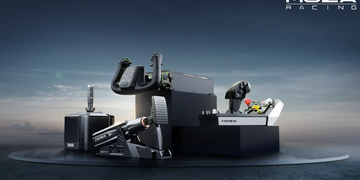
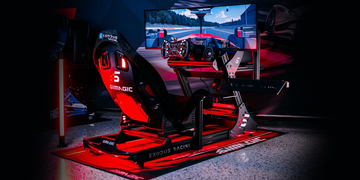
























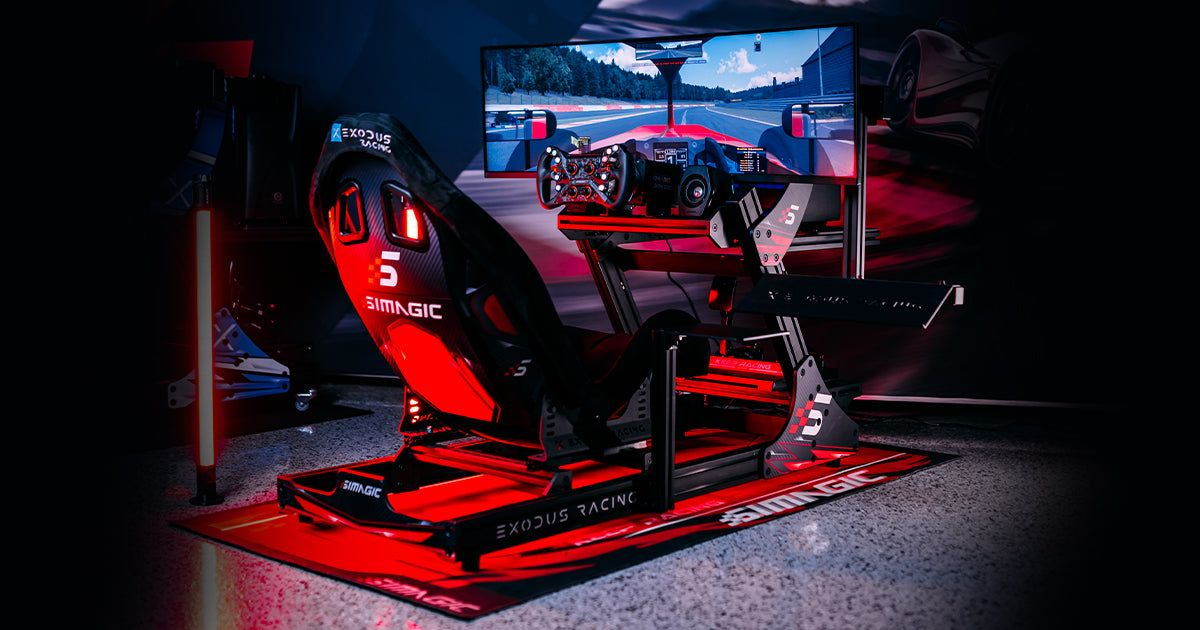
Sim racing hardware has undergone a massive engineering transition, shifting from entry-level enthusiast gear into high-precision, motorsport-grade simulation platforms. Driven by advancements in direct drive servomotors, software-defined force feedback algorithms, dynamic active braking systems, and multi-channel tactile telemetry, modern racing rigs now deliver near-lossless physical telemetry matching the telemetry outputs of real-world GT3, open-wheel, and prototype race cars.
Direct Drive (DD) Ecosystem: Torque, Slew Rate, and Zero Cogging
Direct Drive wheelbases couple the steering rim directly to an industrial brushless servo motor without the latency, mechanical friction, or damping associated with legacy belt- or gear-driven systems.
[Physics Engine Telemetry (1000Hz+)]
                 │
                 ▼
[High-Speed Microcontroller / DSP Filtering]
                 │
                 ▼
[Industrial Servo Base (12–25+ Nm, High Slew Rate)]
                 │
                 ▼
[Rigid Steering Column & Quick Release System]
- Torque Range & Dynamic Overhead: Standard competition wheelbases operate in the 12 Nm to 25 Nm range. This dynamic headroom prevents motor clipping during peak curb strikes or high-downforce cornering, preserving subtle sensations of front-axle grip loss.
- Slew Rate Optimization: Beyond raw peak torque, slew rate (measured in $V/\mu s$ or $Nm/ms$) determines how quickly a motor responds to transient telemetry spikes. Ultra-fast slew rates allow drivers to detect snap oversteer milliseconds before visual cues register on screen.
- Cogging Suppression & High-Resolution Encoders: High-pole servomotors paired with 21-bit to 24-bit optical or magnetic encoders virtually eliminate mechanical cogging, providing smooth rotational resistance and accurate self-aligning torque.
Active Pedals vs. Traditional Load Cell Systems
The most transformative hardware leap in sim racing pedal design is the move from analog mechanical assemblies to motorized active pedal systems.
| Specification / Mechanism | Elastomer & Load Cell Pedals | Next-Gen Active Pedals (Motor-Driven) |
| Resistance Mechanism | Physical polyurethane elastomers and metallic springs. | Integrated precision linear motors / ball-screw actuators. |
| Travel & Curve Profiles | Fixed mechanical travel; requires manual elastomer swaps for stiffness adjustments. | Fully software-configurable travel distance, force curves (linear, progressive, exponential), and preload. |
| Dynamic Telemetry Feedback | Passive resistance only (or small rumble motors on the pedal face). | Live force feedback delivering real-time ABS pulse modulation, bite-point bite/slip, brake fade, and traction loss. |
| Calibration & Maintenance | Subject to elastomer temperature degradation and physical wear over time. | Solid-state telemetry calibration with zero mechanical wear on resistance elements. |
Multi-Channel Haptics & Chassis Telemetry Integration
Immersion and lap-time consistency rely heavily on tactile cues transmitted through the rig's seating and pedal plate:
- Linear Resonant Actuators (LRAs) & Transducers: High-frequency tactile transducers mounted beneath the pedal tray and racing bucket translate specific telemetry channels directly to the driver's body:
- Front transducers: Wheel slip, front lockup, engine RPM harmonics.
- Rear transducers: Rear wheel traction loss, curb impacts, gear-shift kicks.
- Multi-Axis D-Box & Linear Actuator Motion: Motion platforms synchronize pitch, roll, and heave with high-frequency surface detail, simulating chassis weight transfer without introducing disorienting latency.
Structural Rig Integrity: Extruded Aluminum Profiling
The immense dynamic loads produced by 20+ Nm wheelbases and 100+ kg active brake pedals require rigid mounting solutions:
- T-Slot / V-Slot Aluminum Profiles (e.g., 40160 & 40120 Specifications): Heavy-duty extruded aluminum forms the industry-standard foundation, eliminating torsional flex during heavy braking and rapid counter-steering.
- Zero-Play Quick Releases (QR): Automotive-grade spring-loaded or conical clamp quick-release systems ensure uncompromised rotational energy transfer between the motor shaft and the steering wheel hub, preventing flex and signal dropout.