


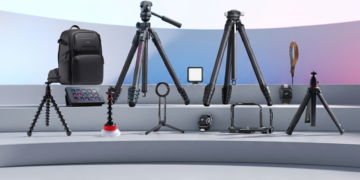











Selecting a travel tripod requires balancing weight constraints against physical rigidity. While studio tripods rely on pure mass for stability, travel tripods must maximize structural damping, minimize packed volume, and withstand dynamic weather conditions without burdening the shooter.
Understanding the engineering differences between multi-layer carbon fiber weaves, CNC-machined aluminum alloys, leg lock mechanics, and space-saving center column geometries ensures the right balance of stability and portability.
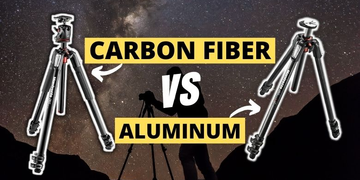
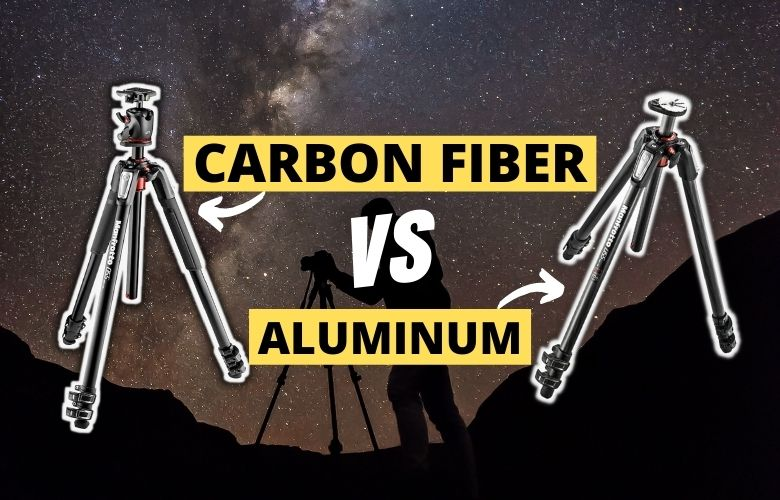
1. Material Science: Multi-Layer Carbon Fiber vs. CNC Aluminum
The core performance of a tripod leg depends on how its material handles vibration propagation, load deflection, and temperature swings.
[Vibration Propagation / Damping Response]

Aluminum:      ─────/\/\/\/\/\/\/\─────────► High Resonance / Slow Damping
Carbon (8x):   ─────/\/\/\─────────────────► Fast Kinetic Dissipation (Fiber Scatter)
High-Modulus Carbon Fiber (8x to 10x Cross-Weave)
- Kinetic Vibration Damping: Carbon fiber consists of microscopic crystalline filaments woven in cross-directional layers (typically 8 to 10 layers in modern travel legs) bonded with high-grade epoxy resin. The microscopic boundaries between fiber strands scatter and absorb vibration energy rapidly, stabilizing slow-shutter exposures in high wind or near crashing waves.
- Strength-to-Weight Ratio: Delivers equal or superior torsional rigidity compared to aluminum while reducing total system weight by.
- Thermal Invariance: Carbon fiber exhibits a near-zero coefficient of thermal expansion. It will not warp, become brittle in freezing sub-zero conditions, or transmit stinging cold to bare hands.
CNC-Machined Aircraft-Grade Aluminum Alloy
- Impact & Abrasion Toughness: While heavier, aluminum legs resist localized crush damage, denting, and deep gouging from sharp rocks better than carbon fiber, which can crack or splinter under sharp point impacts.
- Higher Natural Mass: In low-wind conditions, the extra self-weight of an aluminum frame lowers the tripod’s native center of gravity without hanging extra counterweights on the center column hook.
- Cost-Efficiency: Standard aluminum extrusion and CNC machining deliver reliable performance at roughly half the cost of premium carbon fiber.
2. Leg Locking Mechanisms: Twist Locks vs. Lever/Flip Locks
The locking mechanism dictates deployment speed, weather sealing, and long-term mechanical reliability in the field.
| Locking Mechanism | Engineering Architecture | Field Strengths | Trade-Offs & Maintenance |
| Twist Lock (Collet / M-Lock) | Threaded collar compressing an internal plastic/brass split shim around the leg tube. | Ultra-Compact & Weatherproof: Smooth cylindrical profile will not snag on backpack loops; rubber O-rings block sand, mud, and water ingress. | Requires checking torque by hand; difficult to visually confirm if fully locked at a glance. |
| Lever / Flip Lock (Cam-Action) | Cam-lever clamp exerting direct radial friction on the leg tube. | Instant Visual Confirmation: Clear physical and visual tactile state (open vs. closed); easy to operate while wearing thick winter gloves. | Bulkier exterior profile; external screw tensioners require periodic allen-key recalibration. |
3. Spatial Optimization: Zero-Center Column & Triangular Geometry
Traditional travel tripods suffer from “dead volume”: when three cylindrical legs fold around a central cylindrical column, significant empty air is trapped in between, making the packed diameter bulky ($8\text{cm to }10\text{cm}+$ across).
[Traditional Fold: Trapped Air]        [Zero-Dead-Space / Triangular Geometry]
          ( Leg )                                  ( Leg )
             │                                        │
    (Leg)─[Column]─(Leg)                     (Leg)──[ / \ ]──(Leg)
        (Empty Air)                              (Interlocking Fit)
- Non-Cylindrical / Faceted Leg Shapes: Engineering faceted or nested leg profiles allows the legs to close flush against a custom-shaped center column, shrinking the packed diameter down to the size of a standard water bottle ($6.5\text{cm}$ or less).
- Shortened / Split Center Columns: Removable bottom sections of the center column allow the tripod to drop down to ground level ($10\text{cm to }15\text{cm}$) for dramatic low-angle landscape and macro perspectives without having to invert the camera upside-down.
Top Product Ecosystems & Benchmark Travel Models
Essential Best Practices for Travel Deployments
- Deploy Legs from Thickest to Thinnest: Always extend the top, thickest leg sections first. Only extend the narrow bottom sections if extra height is strictly required, as thinner tubes have higher flex under lateral wind loads.
- Avoid Extending the Center Column in Wind: Elevating the center column turns your camera into an inverted cantilever, amplifying micro-vibrations exponentially. Keep the column fully dropped and hang your backpack from the bottom hook to anchor the rig.
- Field Maintenance After Saltwater / Sand Exposure: When shooting in coastal environments, submerge and rinse the twist locks and lower leg tubes in fresh water, dry thoroughly, and apply light dry PTFE lubricant to the internal shims to prevent corrosion and grit binding.