














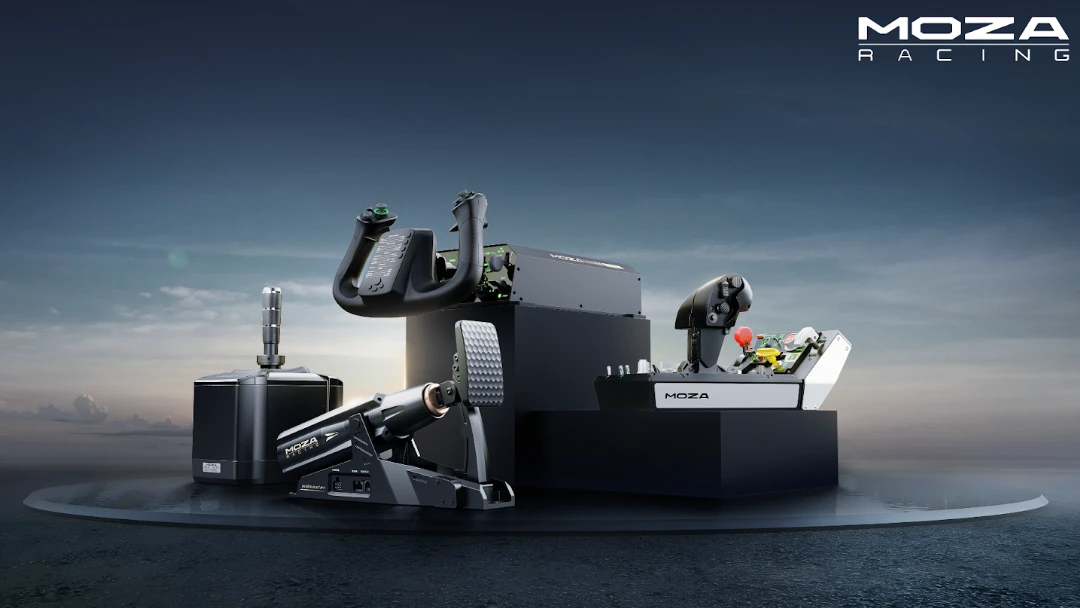
The sim racing hardware sector is undergoing a massive structural shift. Manufacturers like Simucube, Asetek SimSports, Moza Racing, and Fanatec are moving past incremental torque upgrades and analog elastomeric dampers, delivering dual-DSP direct drive architectures and software-defined, motor-actuated active pedals that translate live physics telemetry directly into physical force.
Direct Drive Wheelbases: Dual-Core Processing & Slew Rate Dominance
Modern wheelbases no longer compete on raw peak torque alone. The current benchmark centers on processing bandwidth, ultra-high slew rates, and instant torque delivery without mechanical dampening.
[Physics Engine Telemetry (1000Hz–2000Hz Feed)]
                         │
                         ▼
[Dual-DSP Onboard Controllers (Real-Time Filter Pipeline)]
                         │
                         ▼
[Industrial Servomotor (Ultra-Low Cogging, High Slew Rate)]
                         │
                         ▼
[Lossless Force Feedback & Instant Slip/Curb Sensation]
- Dual-DSP Signal Pipelines: Next-gen bases separate wireless telemetry ingest from internal motor control loops. Dedicated hardware filters smooth out noise and quantization spikes without dulling transient signals like high-frequency curb strikes or sudden front-axle washouts.
- Elevated Slew Rates: Achieving slew rates exceeding 5 to 9 Nm/ms, these motor units react instantaneously to suspension load shifts, giving competitive drivers the millisecond-level window needed to catch snap oversteer.
- Sub-24-Bit Optical/Magnetic Encoders: Encoders with resolutions surpassing 16 million counts per revolution eliminate micro-cogging entirely, providing silky-smooth rotational inertia.
Active Pedals: Motor-Driven Telemetry vs. Traditional Load Cells
Active pedals replace polyurethane elastomers, metallic springs, and hydraulic master cylinders with brushless linear motors and high-precision ball-screw actuators.
| Feature / Metric | Load Cell + Elastomer Pedals | Active Motor-Driven Pedals |
| Resistance Mechanism | Mechanical compression of physical elastomers. | High-torque linear servo motor actuation. |
| Brake Force Curve | Fixed mechanical travel; requires manual component swaps to adjust stiffness. | 100% software-configurable force curves, preload settings, and physical travel limits. |
| Dynamic Haptic Feedback | Small passive vibration motors or no haptic response. | Direct motor modulation simulating real ABS pulses, brake pad fade, and engine RPM vibrations. |
| Profile Hot-Swapping | Requires physical disassembly and tool adjustments. | Instant digital switching between GT3, Formula 1, and Rally configurations mid-session. |
| Maintenance & Longevity | Elastomers degrade, harden, and crack over time. | Solid-state operation with zero mechanical degradation or heat-induced variance. |
Telemetry-Driven Force Feedback Features
- True-to-Life ABS Modulation: When braking exceeds the tire's grip threshold in-game, the pedal actively kicks back against the driver's foot with variable amplitude and frequency matching the simulated car’s ABS ECU.
- Dynamic Bite-Point Emulation: Clutch pedals dynamically drop resistance precisely at the clutch bite point, recreating physical clutch plate engagement for race launches.
- G-Force & Traction Modulation: Integrated firmware can increase brake pedal resistance under high aero downforce and soften it as vehicle speed drops, reflecting real-world hydraulic pressure dynamics.
Ecosystem Integration & Rig Requirements
Deploying 15–25 Nm direct drive bases alongside active pedals with 150+ kg braking thresholds requires structural rigidity:
- Torsional Rig Stability: Standard 8040 and 40160 aluminum profile cockpits with minimum 10mm reinforced steel pedal plates are mandatory to eliminate flex that dampens haptic feedback.
- Unified Software Hubs: Modern companion software allows drivers to download car-specific telemetry curves directly from cloud libraries, matching the pedal feel and steering resistance of specific chassis (e.g., Porsche 911 GT3 R, Dallara F3) in a single click.