









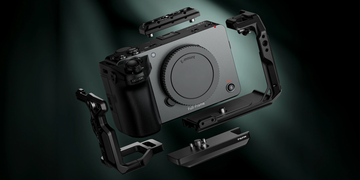











Handheld camera movement is governed by classical mechanics: instability stems directly from the lever-arm distance between the operator’s contact points and the camera assembly's Center of Gravity (CoG). Integrating an engineered handle system shifts contact vectors, dampens rotational micro-jitter (pitch, roll, yaw), and reduces muscular strain during sustained operating blocks.
Beyond basic grip points, modern handle architecture acts as a mechanical counter-leverage frame and an integrated control hub.
1. Kinematic Levers & Center of Gravity (CoG) Balancing
A built camera rig (body, heavy front cine glass, matte box, follow focus, rear V-mount battery, and high-mounted monitor) creates an asymmetric mass distribution.
       [Top Handle Grip Axis]
                 │
                 ▼
       ├─── d1 ──┼─────── d2 ───────┤
       ▼                            ▼
  [Heavy Lens]   ◄── [CoG] ──►   [V-Mount Battery]
- Dynamic Lever Arm Minimization: The torque required to stabilize the rig is defined by $\tau = r \times F$, where $r$ is the perpendicular distance from the handle mount to the system CoG. Sliding top handles (via NATO rail channels) allow continuous fore-and-aft adjustment along the $X$-axis to place the lifting point directly above the system's combined CoG, eliminating forward or backward tilt bias.
- Low-Angle Inverted Pendulum Dynamics: Carrying the rig from a rigid top handle converts an unstable upright balancing task into a self-stabilizing suspended pendulum. Gravity acts as a stabilizing vector rather than an overturning force during low-mode tracking shots.
2. Structural Mount Protocols: ARRI Pin vs. NATO Rail vs. ARRI Rosette
Selecting the correct mechanical interface determines load capacity, vibration resistance, and rotational locking strength:
| Interface Architecture | Structural Standard | Static/Dynamic Load Rating | Torque & Locking Mechanism | Best Rig Application |
| ARRI Locating Spec | 3/8″-16 UNC + Dual 3mm Retractable Steel Pins | High ($>40\text{ kg}\cdot\text{cm}$ torque resistance) | Rigid screw-down + dual shear-pin anti-rotation slots | Fixed top handles, heavy cinema payloads, underslung carrying |
| NATO Rail & Clamp | Standard 21.2mm Dovetail + Spring Detent Pins | Medium-High ($10\text{ to }15\text{ kg}$ axial load) | High-pressure friction wedge + end safety stop pins | Quick-release top handles, modular slide-and-lock side grips |
| ARRI Standard Rosette | 31.8mm Diameter + 60-Tooth Beveled Mesh ($M6$ center thread) | Extreme ($>60\text{ N}\cdot\text{m}$ locking torque) | Interlocking radial serrations ($6^\circ$ step resolution, $360^\circ$ rotation) | Articulating side handles, shoulder rig dual-handgrip extensions |
| Dual 1/4″-20 / 3/8″-16 Direct | Parallel threaded spacing ($18\text{mm}$ standard) | Medium | Dual-bolt constraint (prevents single-screw pivoting) | Lightweight side grips, secondary cage stabilizer brackets |
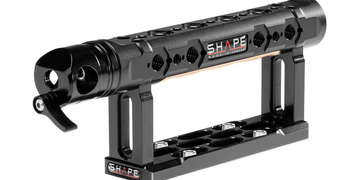
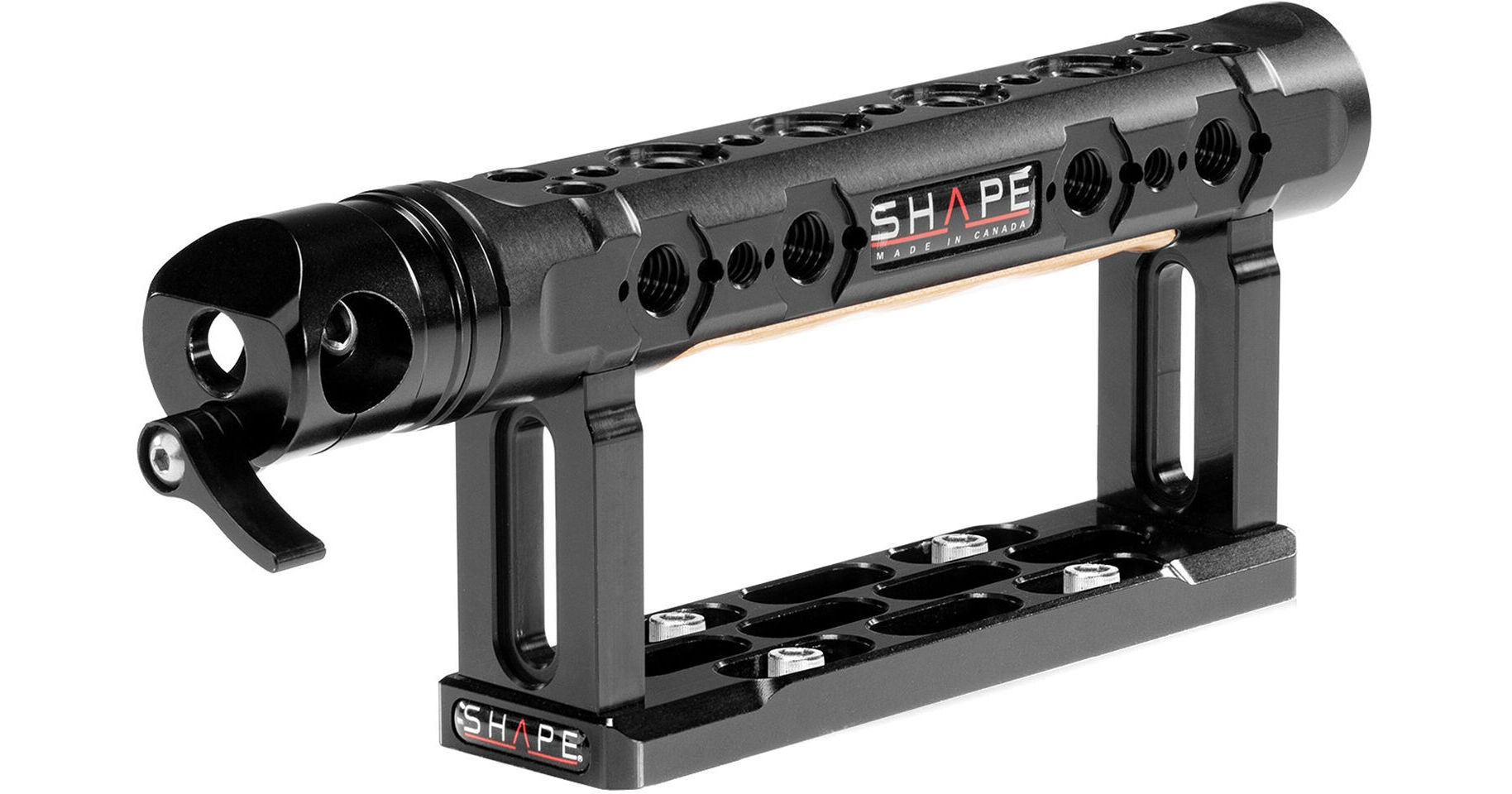
3. Top Handle Architecture: Structural Rigidity & Payload Distribution
A professional top handle must support heavy overhead loads without mechanical deflection while serving as an accessory routing bridge.
       ┌───────────────────────────────┐
       │     Top Handle Grip Body      │ ◄── Contoured Carbon Fiber / Hardwood / NBR
       └───────┬───────────────┬───────┘
               │               │
      [Front Extension]        [Rear Bridge Mount]
               │               │
       ├─ Cold Shoe / ARRI 3/8"├─ 15mm Single Rod Port (EVF / Focus Motor)
       └─ Monitor Tilt/Swivel  └─ Wireless TX / Timecode Box Bracket
- Modular Closed-Loop vs. Open T-Bar: Open cantilever handles flex under heavy payloads. Closed-loop top handles (bolted to both the front top-plate and rear battery plate) create a rigid structural bridge, distributing lifting shear forces across the entire cage perimeter.
- Transverse Axis Expansion: Top handles feature integrated 15mm single-rod ports for mounting electronic viewfinders (EVF) or wireless focus motors, alongside multiple anti-twist 3/8″-16 ARRI threads to support heavy onboard monitors without swivel failure.
4. Side Handle Kinematics & Ergonomic Contact Materials
Side handles provide horizontal stabilization, counteracting roll and yaw torque during fast pans and uneven foot travel.
- Two-Handed Triangular Stance: Positioning the primary hand on the right side handle and the support hand on the left side handle forms a triangular support base with the operator's chest, damping high-frequency muscle tremors.
- Vertical Height & Angular Adjustment: Quality side grips feature slotted sliding brackets (vertical $Y$-axis travel up to $45\text{mm}$) and axial tilt mechanisms to align with the operator’s natural neutral wrist angle ($15^\circ\text{ to }20^\circ$ dorsiflexion), preventing carpal tunnel strain during multi-hour shoots.
- Haptic Materials & Thermal Isolation:
- Contoured Brazilian Rosewood / Walnut: Naturally sweat-absorbent, warm to the touch in freezing conditions, and provides organic micro-grip friction.
- Overmolded NBR Silicone / Textured Rubber: High shock-absorption coefficient, non-slip under rain, and resistant to oil/sweat degradation.
- Skeletonized Carbon Fiber: Maximum strength-to-weight ratio with near-zero thermal conductivity.
5. Electronic Control Integration: LANC, USB-C & Bluetooth Run/Stop Protocols
Modern cinema and hybrid camera handles consolidate camera control directly into the grip to eliminate hand repositioning during recording.
[Operator Thumb Trigger]
           │
           ▼
┌───────────────────────┐
│ Integrated REC Switch │ ◄── Momentary Electronic Switch (IP54 Sealed)
└──────────┬────────────┘
           │
           ├─► USB-C Protocol (Sony Multi-Terminal / Canon / Panasonic USB Control)
           ├─► 2.5mm LANC Standard (Blackmagic / Cine Cameras)
           └─► BLE Wireless Link (Direct Wireless Shutter / REC Pairing)
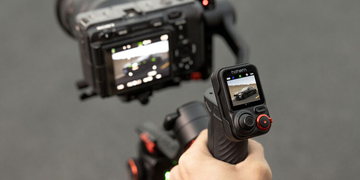
- Electronic Run/Stop (REC) Triggers: Tactile momentary micro-switches positioned directly under the index finger or thumb allow instant record triggering without introducing hand movement to the camera chassis.
- Modular Multi-Camera Cable Interfaces: Detachable control cables convert the handle's internal control board to Sony Multi/Type-C, Panasonic 2.5mm, FUJIFILM remote, or standard 2.5mm LANC.
- Internal Media & Battery Storage: Advanced side grips incorporate internal slots for compact Samsung T5/T7 SSDs (with cable strain clamps) or modular NP-F550/LP-E6 battery cavities that deliver auxiliary power to the camera or follow-focus motor directly through the grip.